Rizal beside me.
My Journey with Jose Rizal
From clues to causes to action
ROBERTO, ROI VICTOR PILAR | GERIZAL Y12
Rizal beside me.
From clues to causes to action
This portfolio follows how my understanding of Rizal changed across four modules. I began with a familiar national symbol: a name attached to monuments, classrooms, and the story of Philippine independence. The readings made that image more difficult and more useful. I learned to ask how heroism is formed, what conditions shaped nineteenth-century Filipino nationalism, how family and education formed Rizal as a person, and what remembrance demands from a student today.
I am a computer science student at De La Salle University interested in software engineering, artificial intelligence, quantum computing, algorithms, mathematics, and science. Project and competition work have trained me to look for patterns, test assumptions, and explain decisions. This course challenged me to bring the same habits to history without reducing people to data or treating technology as automatic progress. It also reminded me that evidence is never only technical: sources have contexts, interpretations have consequences, and people affected by a decision deserve to be heard. My journey moved from clues, to causes, to action: from examining claims about Rizal, to tracing the systems behind them, to asking who benefits from what I learn and build.
Module 1 changed my question from “Why is Rizal a hero?” to “How and why has he been remembered as one?” Republic Act No. 1425 presents Rizal’s life and writings as resources for civic conscience, but the controversy surrounding the law also shows that education is never separate from religion, political power, and freedom of interpretation. Teodoro M. Locsin and John N. Schumacher helped me see how strongly people disagreed about what students should read and what the state could require.
Renato Constantino’s “Veneration Without Understanding” complicated the heroic image further. His criticism made me consider Rizal’s reformism, his distance from the 1896 Revolution, and the role later institutions played in presenting him to the public. Esteban A. de Ocampo’s discussion of Filipino recognition reminded me, however, that Rizal’s standing did not begin with American sponsorship. Filipino admiration, revolutionary remembrance, his writings, and his martyrdom were already part of the historical record.
I learned that I do not have to choose between blind praise and complete rejection. Heroism can involve genuine contribution, limitation, public memory, and later political use at the same time. Critical reading is not disrespect. For me, it is a more serious form of respect because it asks whether admiration can survive evidence, disagreement, and context. This module gave me a better standard for judging public figures: examine what they did, the choices available to them, the limits of those choices, and the interests behind the story we inherit.
Module 2 taught me that nationalism did not appear because one exceptional person suddenly inspired an entire population. Benito J. Legarda Jr. shows how nineteenth-century changes in trade, transport, communication, education, and the native middle class created new aspirations and material conditions. Infrastructure moved more than goods. Steamships, the Suez Canal, banks, railways, and faster communication moved people, books, news, and comparisons. Filipinos who encountered wider ideas could see both what modernity made possible and what colonial rule continued to withhold.
Zeus A. Salazar added another difficulty. The familiar precolonial–colonial–postcolonial division once helped Filipino thinkers oppose Spanish historical ideology, yet it can still keep colonialism at the center of how we organize our past. His argument made me ask not only what a historical account says, but whose perspective gives it structure and what that structure pushes to the margins.
This systems view feels relevant to my field. Digital platforms and artificial intelligence can widen access to information, but they can also reproduce inequality, hide assumptions, and accelerate misinformation. A new system is not automatically progress simply because it is faster or technically impressive. The important questions are who can use it, whose language and experience shaped it, who remains excluded, and whether it strengthens people’s ability to decide for themselves. Module 2 moved nationalism away from a slogan. I began to see it as a historically formed practice of identifying shared conditions, questioning inherited viewpoints, and deciding what kind of future a community will build together.
Module 3 made Rizal less distant. “Memoirs of a Student in Manila” shows a developing person shaped by family, early education, grief, faith, imagination, and separation from home. In my “Rizal and Me” activity, I reflected on how family support has also shaped my education. My situation is not equivalent to Rizal’s, but recognizing the importance of support helped me understand that public achievement grows from private formation, opportunity, discipline, and relationships.
The later writings show what Rizal did with that formation. In The Indolence of the Filipino, he does not simply deny the accusation of indolence. He acknowledges an observable problem and investigates the conditions that produced it: misgovernment, insecurity, forced labor, restricted commerce and opportunity, inadequate education, curtailed liberty and association, and work with little meaningful reward. In The Philippines a Century Hence, he studies the past and present to consider possible futures. I read it as conditional historical analysis, not supernatural prophecy.
Miguel A. Bernad’s discussion of Rizal’s trial added a lesson about fairness. A process can use legal forms and still fail to provide justice when evidence, power, and the rights of the accused are unequal. This connects with a concern I carry into team and technical work: a decision can look orderly while its assumptions or incentives remain unfair. Education matters when it helps me notice those conditions, not only when it creates personal opportunity. By the end of this module, Rizal no longer seemed like a finished saint. He became a historical person whose curiosity and discipline produced powerful analysis, but whose ideas and choices still need to be read within their time.
Module 4 gave the course its hardest challenge: “Make Rizal obsolete.” I no longer understand Renato Constantino’s phrase as a call to erase or forget Rizal. It means building a Philippines where the corruption, inequality, dependence, and indifference he criticized are no longer normal. Jose W. Diokno’s “Rizal for Today” shows how old structures can survive under new names, while Setsuho Ikehata connects knowledge of a shared past with national consciousness and collective action.
The Lasallian readings made the challenge personal. Wilfrido V. Villacorta, Carmelita I. Quebengco, and Bro. J. Benedict, FSC connect education with learners who are neglected, Filipino realities, workable institutions, and continuity. Their arguments changed how I think about achievement. Knowledge is incomplete when it advances only my career. In software and AI, I should ask who defined the problem, whose language is treated as normal, who has access, who carries the risk, and whether the result can be maintained after its presentation.
This does not mean that one student project can solve a national problem. It means refusing to use small scale as an excuse for carelessness. A responsible project can begin by listening, documenting evidence and assumptions, testing with intended users, reporting limitations, and leaving a usable handoff. Rizal’s relevance is not proven by repeating his name. It is proven when his questions shape ordinary decisions and public responsibilities. He becomes “obsolete” only through collective work that removes the injustices that made his criticism necessary. Until then, remembrance should keep moving toward action.
The Indolence of the Filipino is my favorite written work because Rizal refuses the easiest explanation. Colonial writers treated Filipino indolence as an inherent defect and used the label to explain economic and social conditions. Rizal does not avoid the uncomfortable observation that indolence could be seen. Instead, he changes the question from “What is wrong with Filipinos?” to “What conditions made sustained work insecure, unrewarding, or impossible?” He discusses war, forced labor, insecurity, restricted commerce, inadequate education, curtailed liberty and association, and weak incentives. His argument turns the stereotype from a supposed cause into an effect of damaging institutions.
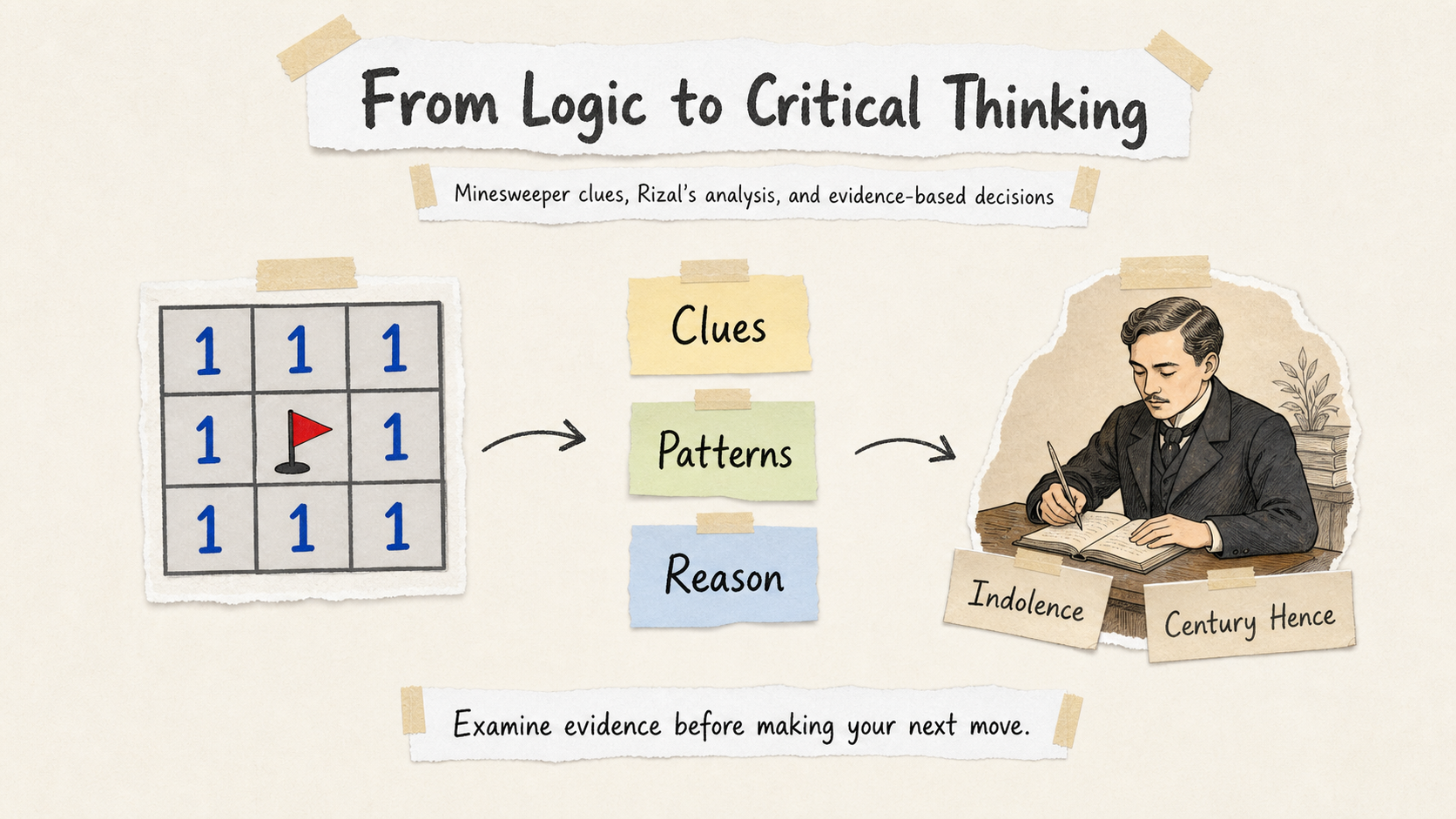
I value the method as much as the conclusion. In computing, a failed system, inaccurate model, or poor user outcome should not be explained by blaming the user or accepting the first convenient story. We trace evidence, conditions, incentives, and root causes. That is also what I practice in Minesweeper No Guessing mode: a good move follows available clues, while a confident guess without enough evidence can create avoidable harm. The comparison has limits, because society is not a puzzle with one hidden answer. Still, both activities teach me to make uncertainty visible, look for missing information, and resist the confidence of an unsupported conclusion.
I do not treat every sentence of the essay as beyond criticism. Some assumptions, especially its climate-based generalizations, belong to the nineteenth century and should be questioned. What remains powerful is Rizal’s refusal to confuse a symptom with its cause. The essay reminds me to slow down before judging people, inspect the system shaping their choices, and design remedies that restore education, freedom, opportunity, and collective agency.
Its Spanish title, Sobre la indolencia de los filipinos, also reminds me that translation and historical context matter when a work travels across audiences.
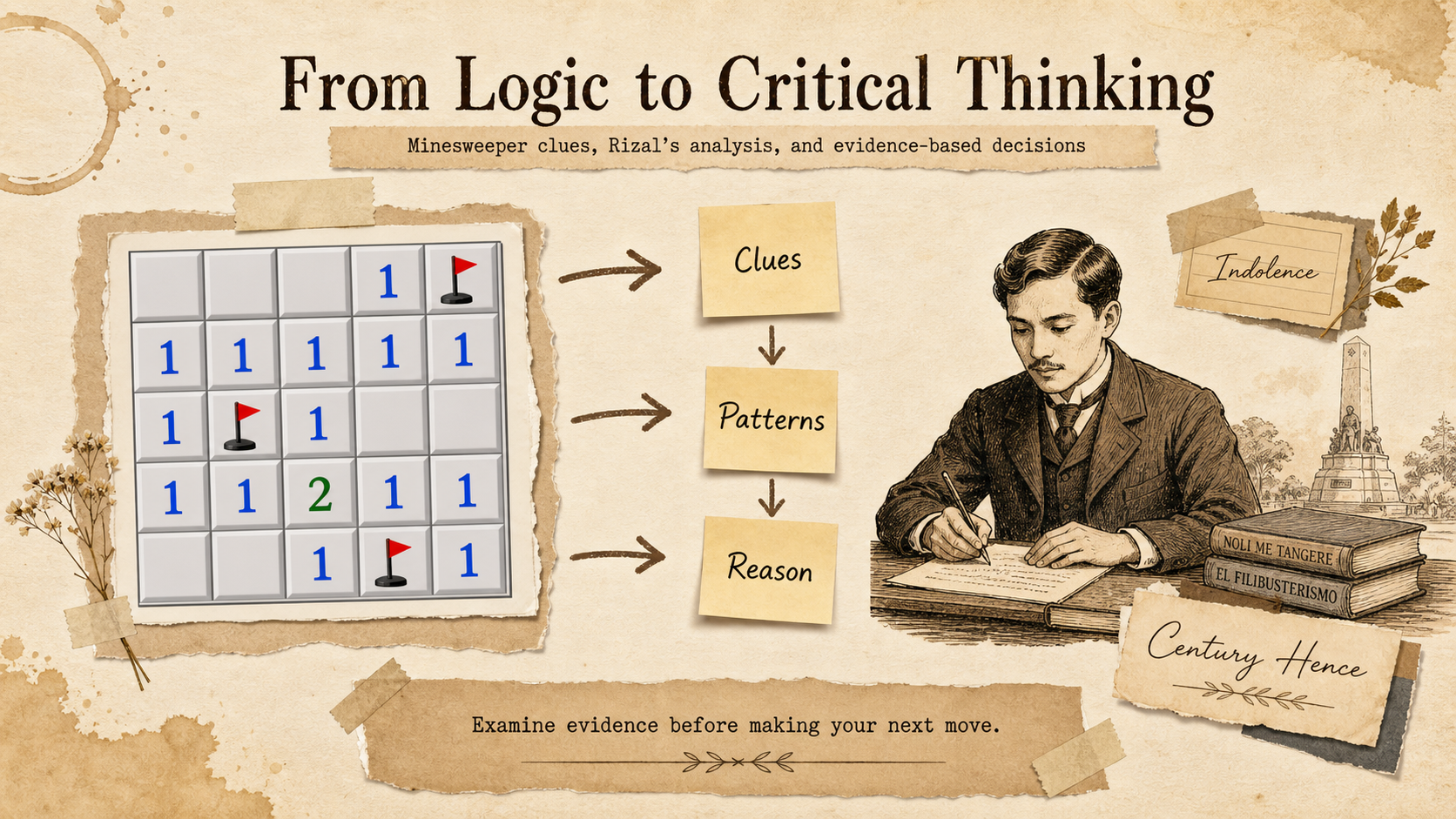
It supports the favorite-work analysis by showing why I value methods that separate evidence, assumptions, symptoms, and root causes.
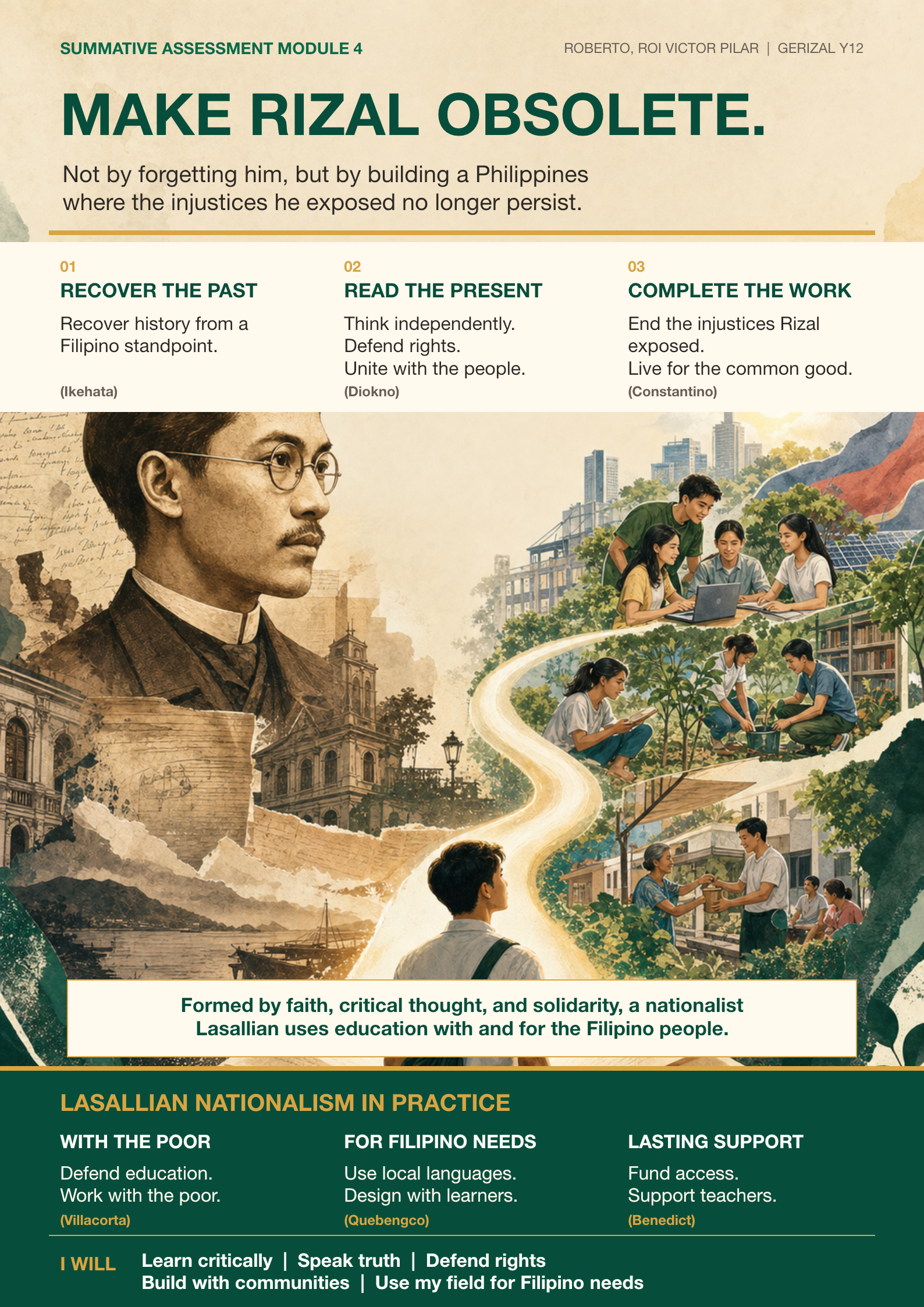
Using a past–present–future sequence, the poster argues that shared history should lead to collective action against continuing injustice.
A hero can be honored while his choices, context, and limitations are examined honestly.
It grows through shared history, education, rights, language, and collective action.
Before blaming individuals, examine the structures shaping opportunity, incentives, and choice.
Skill matters more when it is accessible and useful beyond private success.
Evidence, documentation, accountability, resources, feedback, and maintenance determine whether service lasts.
Pause
Before choosing a service-oriented technology problem, I will complete and document at least one needs session with intended users or a partner group.
at least one documented needs session
Verify
Before sharing a significant academic or civic claim, I will check the original source, separate fact from interpretation, and examine one credible counter-perspective.
one original source and one credible counter-perspective
Explain
For each team project, I will document decisions and contributions, give proper credit, and record the context behind major choices.
documentation for each team project
Act
Before graduation, I will co-design one small accessible or bilingual digital tool or learning resource for a defined Filipino need and test it with at least three intended users.
at least three intended users
Act
I will record feedback and limitations, provide a feedback channel, and leave maintenance or handoff documentation.
a feedback channel and handoff documentation
Rizal’s life does not give me a script to copy. It gives me questions to carry: What evidence am I using? What conditions produced the problem I see? Who benefits from my education? Whose experience is missing from the system I am building? My journey with Rizal continues whenever those questions change a decision. The goal is not to imitate one hero or treat technology as a heroic answer. It is to practice careful judgment, use education responsibly, and join work that makes injustice less ordinary. From clues, to causes, to action, remembrance becomes meaningful when it changes what I choose to build and whom I choose to serve.